I’ll be playing at Cafe Oto on Sunday 1 March, both in a duo with Ian Stonehouse on Shozyg, and as part of a group of wonderful improvisors exploring the work of Gentle Fire.
Hear an excellent recent Gentle Fire release on Clive Graham’s Paradigm discs here.
Tickets and further information here.
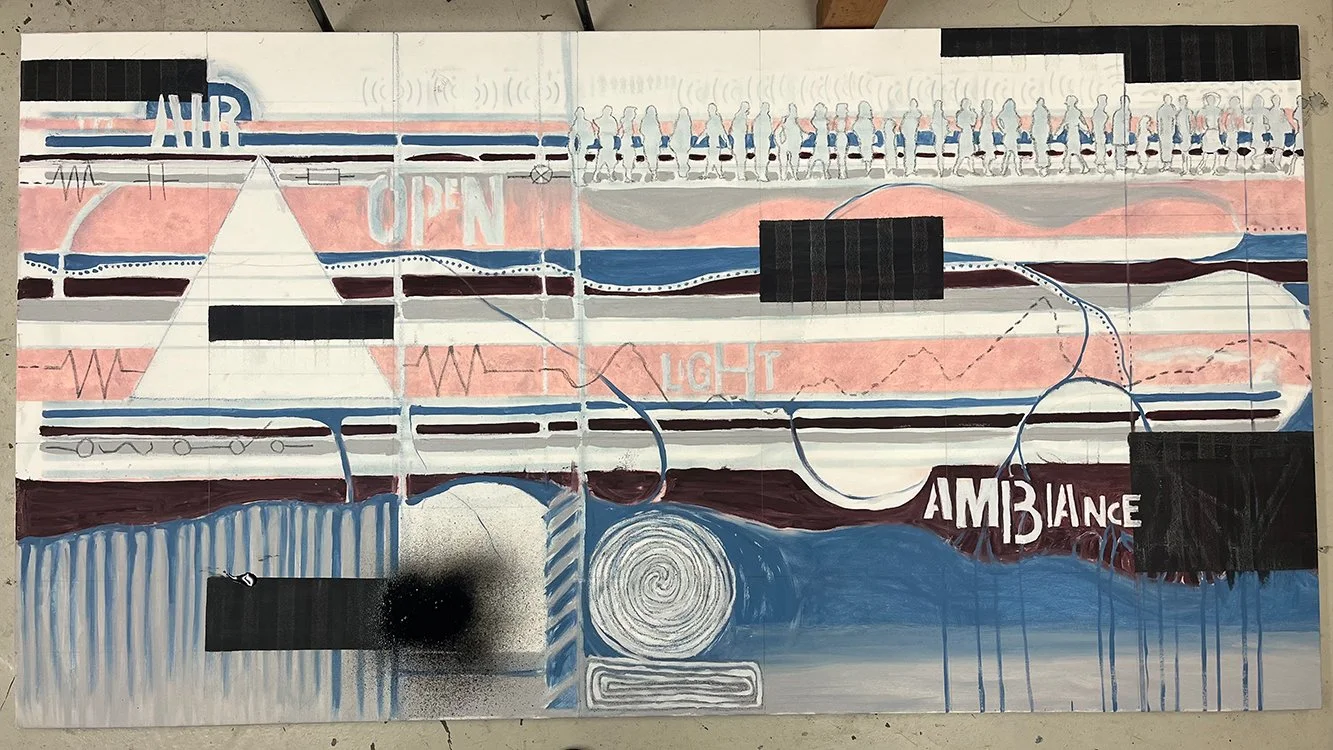
Graphic Score by Tansy Spinks
Gentle Fire Reimagined
- Phil Durrant / amplified objects, prepared dulcimer stick, & electronics
- Steve Beresford / amplified objects, electronics, piano
- Marjolaine Charbin / piano, contact mics, objects, voice
- Ian Stonehouse / Shozyg & electronics
- James Bulley / Shozyg & electronics
- Tansy Spinks / electric violin, amplified objects & electronics
- Khabat Abas / cello and Hugh Davies string instrument
- Mark Wastell / small percussion, spring reverb, contact mics, double bass
Gentle Fire were a 6 then 5 member group of composers / improvisers / performers based in London and Yorkshire. They were active between the years of 1968-1975 and at the time, were one of a handful of groups using electronics, self-built instruments, as well as acoustic instruments in live performance settings.
The core members were Richard Bernas - piano, percussion, Hugh Davies - self-built instruments & electronics, Graham Hearn - VCS-3 synthesiser, recorder, keyboards, Stuart Jones - trumpet, ‘cello, and Michael Robinson - ‘cello, electronics. Richard Orton - tenor voice, live electronics and Patrick Harrex - violin, percussion, were also members in the early years.
The group played concerts, festivals, radio broadcasts all over Europe and were involved in premiers and early performances of important pieces by Stockhausen, Cage, Wolff, Brown, Grosskopf, Ichiyanagi, Lucier, a.o. In addition, they performed Group Compositions and nearly all the members created individual works that were included in their repertoire.
The chosen pieces offered considerable freedom for the performers and were often notated verbally, occasionally graphically and frequently without precise instrumentation.
Core member High Davies analysed live electronic music ‘as the simultaneous live electronic transformation of sounds whose sources fall into one or more of four categories’ and stated the group explored all four categories which were, sounds played on:
conventional instruments (or quasi-con-ventional invented instruments);
on found or adapted objects (or equivalent noise-making invented instruments);
on electronic oscillators or instruments (which, like synthesizers, may incorporate their own modification devices);
and sounds replayed from earlier re-cordings (which more recently would include samplers).
For this concert entitled Gentle Fire Reimagined, we will acknowledge the importance of the group and respect their legacy. We do however recognise that we have different backgrounds, experiences and history. We also recognise that technology has moved on since the 1970s. So this concert will not be an authentic reproduction of their performances / recordings but will be influenced / inspired by the group’s aesthetics and range of instruments used. Having said that, we will performing some of their repertoire including Stockhausen’s text pieces and utilising graphic scores and playing some of our ‘group compositions’. We will also expand the repertoire to include text and graphic scores by Pauline Oliveros and Tansy Spinks a.o. In addition, Ian Stonehouse and James Bulley have rebuilt Hugh Davies’ Shozyg instrument and Khabat Abas will be repairing and using a Hugh Davies cello-like instrument.
My interest and inspiration came from research but was sparked by the release of the triple album ‘Explorations (1970-1973)’ https:// gentlefire.bandcamp.com/album/explorations-1970-1973 and an online article in The Wire, ‘Flame on_ Gentle Fire revisited’.
The concert will feature small group performances but will end with the entire group performing a text piece. Professor Simon Emmerson will be on hand to introduce the concert.
– Phil Durrant