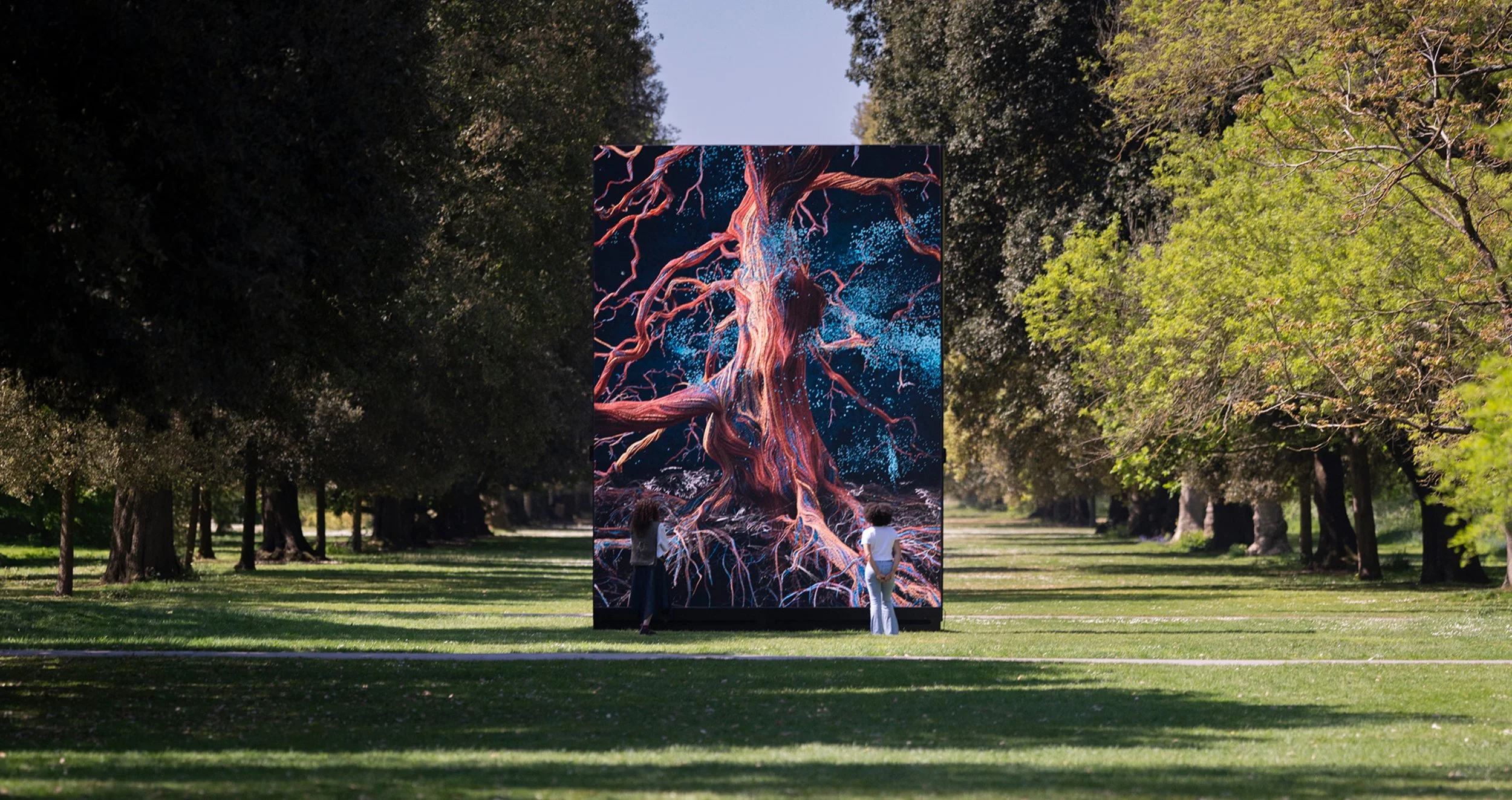
Of the Oak
by Marshmallow Laser Feast
Music & Spatial Sound Design: James Bulley
2025
Interactive video work
9.6.1 Multichannel sound
6 December 2025–15 March 2026, Yorkshire Sculpture Park, UK [visiting information]
3 May –28 September 2025, Royal Botanical Gardens Kew, UK [visiting information]
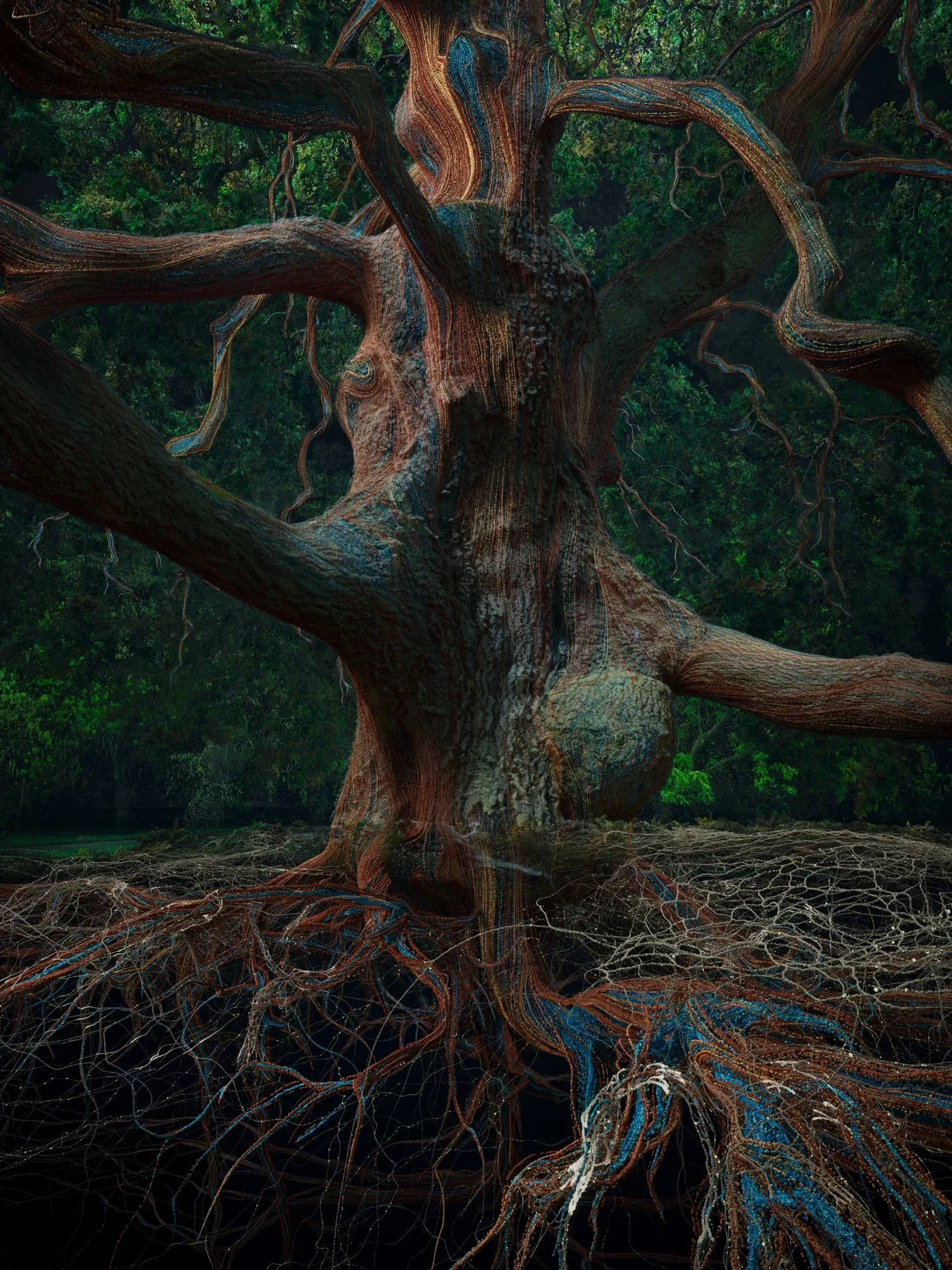
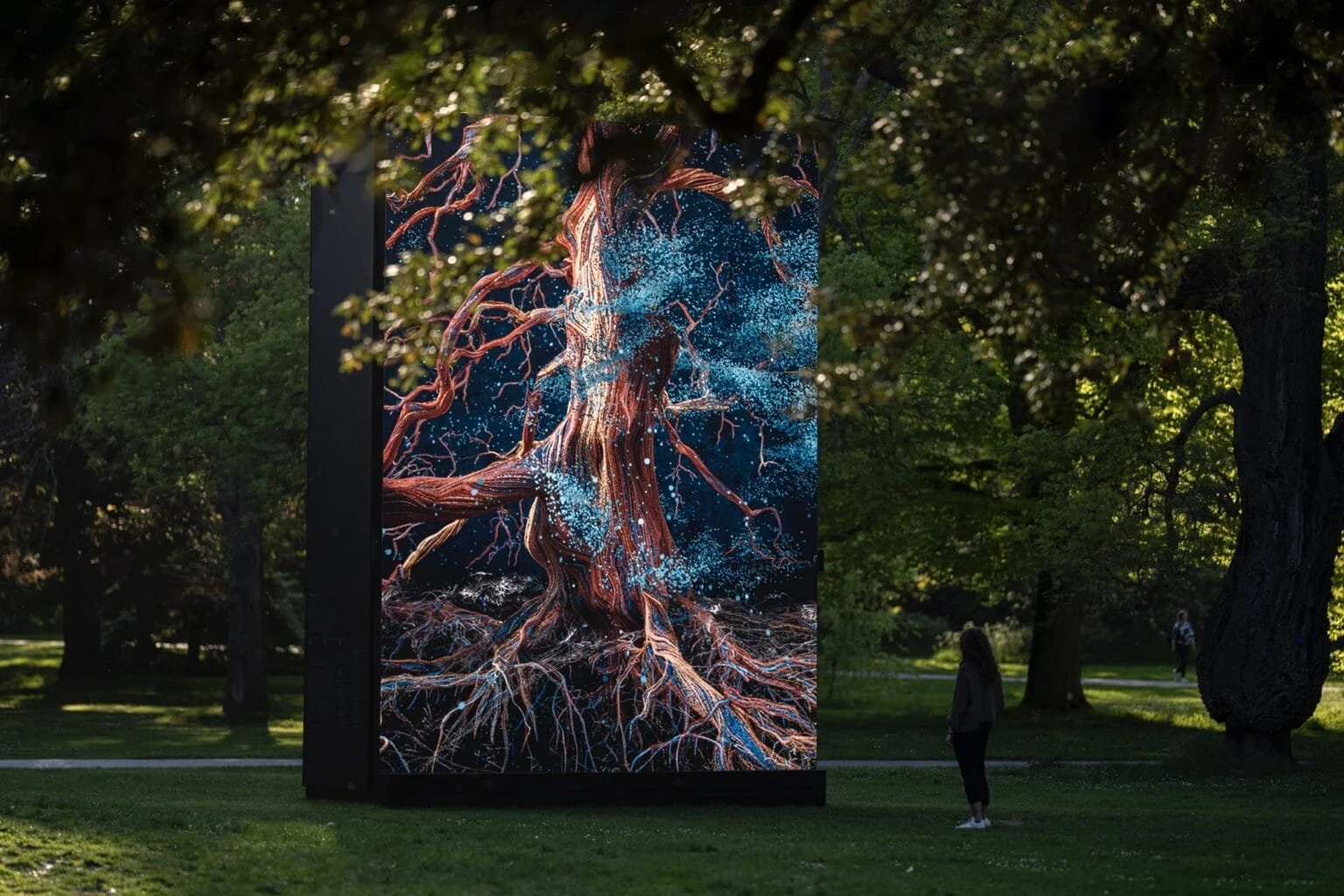
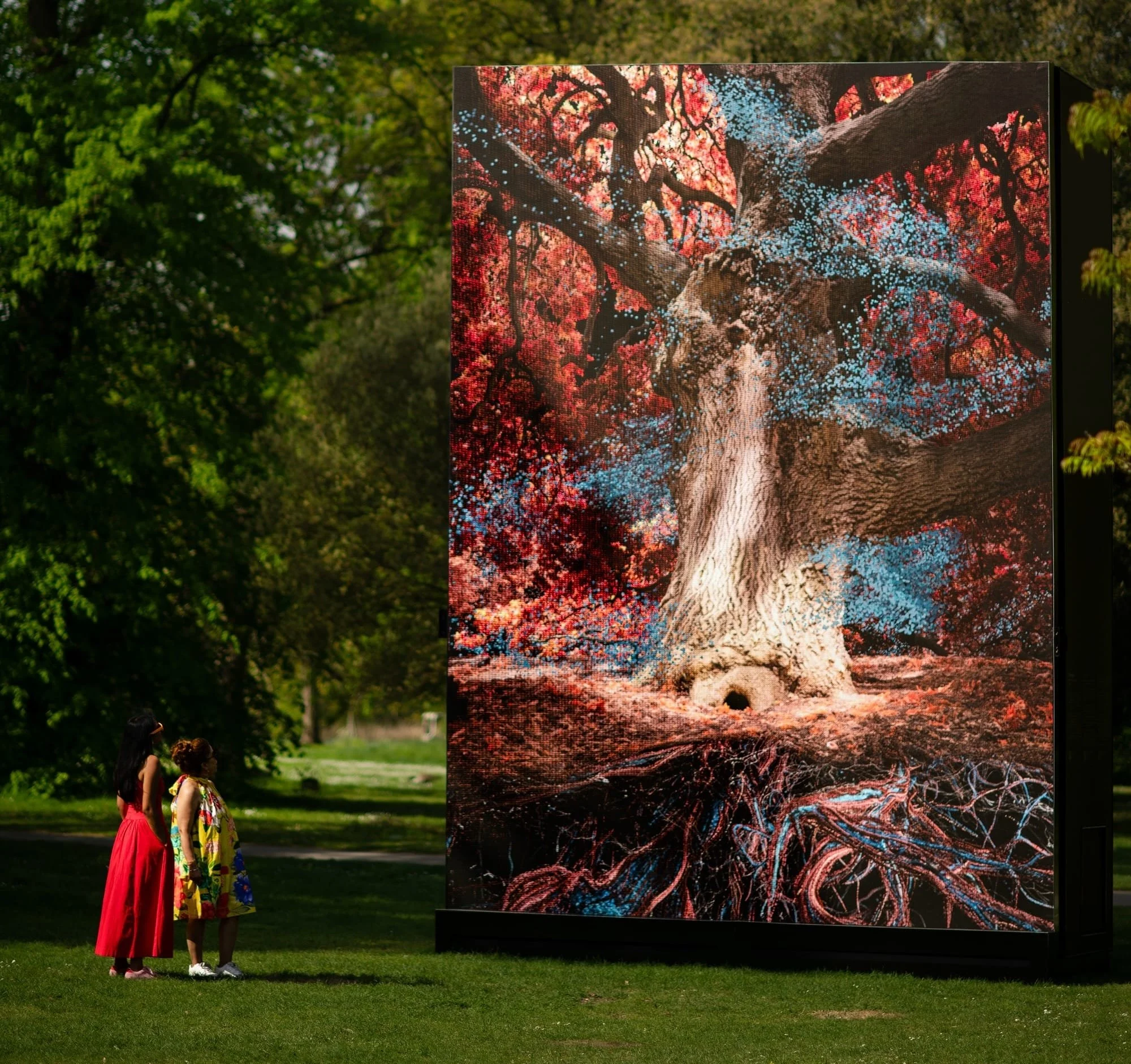
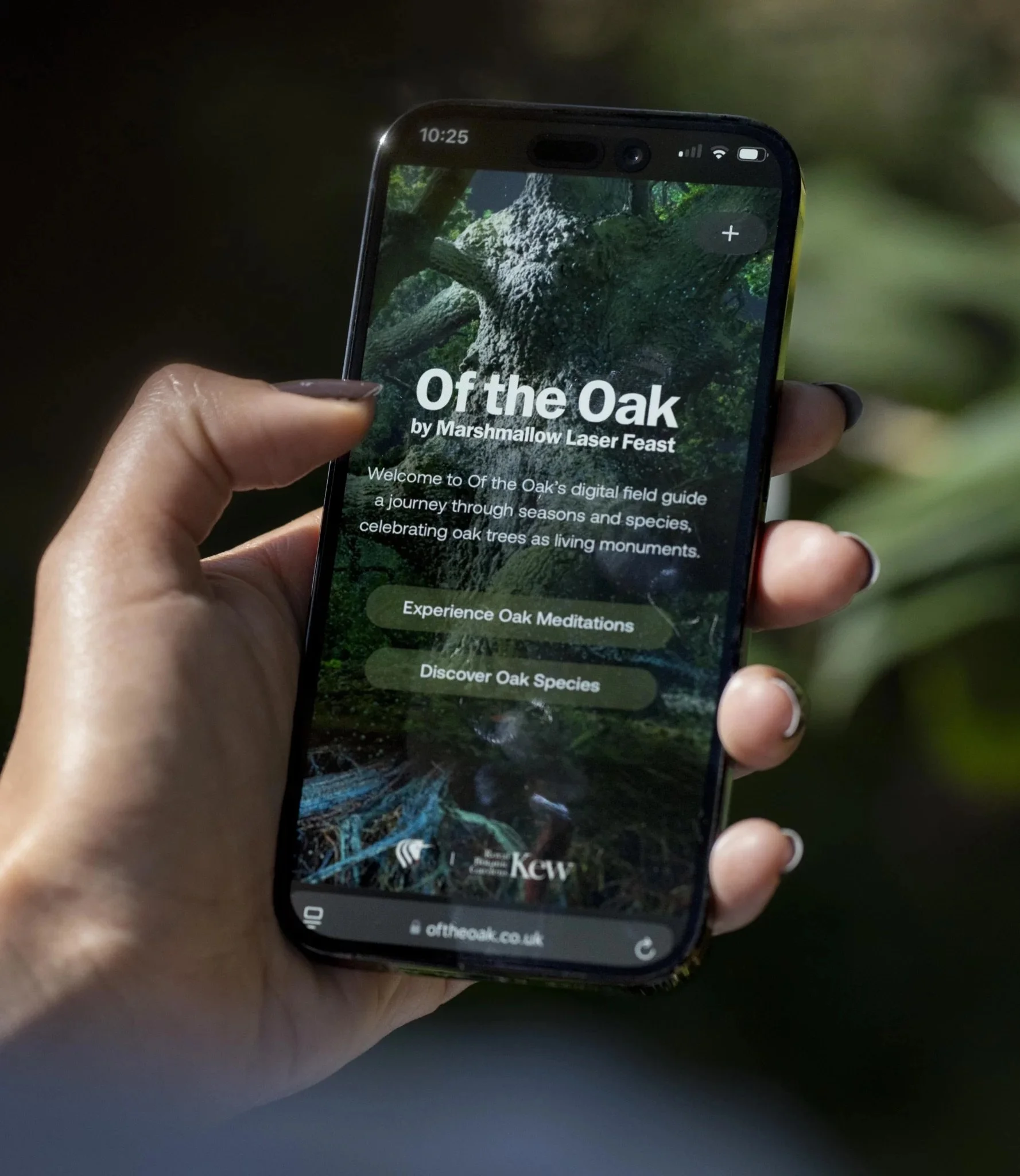
Of the Oak is a large-scale site-specific spatial film-sound artwork accompanied by a set of open-eyed sound meditations and an online field guide that explores the vast array of species associated with the Lucombe Oak at the Royal Botanic Gardens, Kew. The piece was created by Marshmallow Laser Feast in collaboration with numerous ecologists, biologist and researchers from Kew, employing a number of advanced techniques in its realisation: photogrammetry; LiDAR scanning; CT scanning of soil samples; ground-penetrating radar; long-durational spatial sound recordings and in soil recordings.
Artist statement
Of the Oak is an invitation to witness the tree as a living monument of connection, a keystone in the web of life. Majestic, yet unassuming, it reaches its branches skyward and roots deep into the soil, sustaining life.
By peering through the oak’s layers, we uncover a vibrancy that flows through and beyond its body. The pulse of nutrients through its phloem echoes our own heartbeat. This rhythmic journey, from crown to soil, culminates in rivers of carbon, interwoven with the mycelial bridge that connects land and sky. In this underground network, we see that no self is isolated; all are porous, enmeshed, entangled.
The oak’s meaning stretches far beyond bark and bough. Its limbs embrace whole ecosystems, providing shelter and food for more than 2,300 species [1]. From lichens anchored to bark to birds building nests overhead, butterflies fluttering through the leaves to fungi weaving the soil below—countless companions of the oak adapt, flourish, and coexist in a mutual rhythm of growth and revival. In acknowledging this complexity, we confront our own plant blindness, our tendency to overlook the aliveness of plants because they move to a rhythm slower than ours.
This shift in perspective reveals a framework of reciprocity, where all beings exist in cycles of giving and receiving. As our connection to the Earth frays, this work stands as an invitation to extend our imagination to include the vastness of trees. In turn, we also open ourselves to a deeper relationship with the living world.
For over a million years, oaks have taken root in Britain’s soil, their story etched into the fabric of the land. As ice ages came and went, they withdrew and returned, reclaiming ground alongside animals and, eventually, humans. Yet today, these rooted beings stand at a threshold. What once seemed eternal now leans toward fragility, its fate entwined with our capacity to care. As we gather in its shade, we are called to become part of its story—to ensure it is not only remembered, but continued.
Marshmallow Laser Feast, 2025
Mitchell, R.J. et al Oak-associated biodiversity in the UK (OakEcol) [https://doi.org/10.5285/22b3d41e-7c35-4c51-9e55-0f47bb845202]
Excerpt (binaural stereo) from Of the Oak by Marshmallow Laser Feast
Excerpt (binaural stereo) from Of the Oak by Marshmallow Laser Feast
Composing Of the Oak
The central installation for Of the Oak involves a multilayered site-specific sound composition featuring field recording, music and sound design, heard across a bespoke multi-channel speaker system of 9 speakers around the screen and 6 speakers embedded in the ground in front of the installation work.
The piece was recorded and composed over an eighteen month period, with each aspect developed in parallel and informing each other. Initially, in depth ecological surveys of the Lucombe Oak tree at Kew Gardens ascertained all of the individual living (and non-living) species that exist within the ecology of the Oak. This included understanding their behaviours across both different seasons, and through dawn, day, dusk and night. This data then informed the plan for field recording, how the score for the music for the piece would unfold, and how the spatial speaker system that underpins the piece could be designed.
To create the natural soundscape for the piece across the seasons, there was an in depth process of field recording capturing the sounds of the vast array of species that live with and within the oak. This included 24-hour 8-microphone spatial recordings of the canopy of the Lucombe Oak itself at Kew Gardens (recordings which were then mapped spatially into the piece in its final installation form), and of similar oak trees and oak-centred ecologies at both Kew Wakehurst and at Burridge Copse in South Somerset.
Further to these multi-channel recordings in and around the oak trees (which gave highly detailed spatial soundscapes across seasons and weather conditions), there are around one hundred detailed ‘spot’ recording within the piece, allowing for individual key aspects to be ‘highlighted’ sonically at relevant times of the day, night and in particular seasons. These sound design elements and recordings, which encompassed both living species such as flies, bees, butterflies, birds and bats, as well as rain, leaf susurrations, fungi, xylem and phloem, were made over the 18 month period using a variety of different hypercardioid, omni and bespoke microphones in locations with oak-centred ecologies. A number of recordings were made using Ecoutic and hydrophone microphones, allowing the specific addition of textural soil and underground sound recordings that portray the dynamic interactions of the mycorrhizal fungi within the piece.
The natural soundscape was then composed together spatially such that individual species and aspects are heard dynamically where you would expect to hear them - moving and appearing at different times of the day and night just as they do in real-life. Fungal interactions are heard from the ground beneath your feet, wind in the leaves from the tops of the tree, mosquitoes zip and buzz across the understory and around your feet, crows caw in the distance as they fly and land in the branches of the oak. The highly detailed spatial aspect that underpins Of the Oak is achieved through a bespoke 14.1 spatial sound system that is embedded all around and within the monolithic screen at the installation site, and through a 6 speaker-channel sound system embedded under the audience’s feet in the ground.
The music for the piece was composed as a series of scored movements that represent each season and time period that the installation goes through. The score draws from patterns present within the physicality of the oak (leaf structures, bark, seasonal colouring, bioacoustics) and is arranged for violin, cello, piano and a bespoke Shozyg instrument. After the score was written, it was recorded in a series of studio sessions with an array of musicians including Daniel Pioro (violin), Audrey Riley (cello), Ian Stonehouse (Shozyg) and Katherine Tinker (piano). The addition of Shozyg allowed for improvisation with natural materials from the oak (galls, leaves, bark and twigs) through contact microphones.
Of the Oak is written in a 5/4 metre, in harmony with the 5x5 breathing rhythm of the visual work, bringing the music and natural soundscape of the piece into one rhythmic world. This pulsing 5x5 breathing rhythm underpins all of the visual and sonic elements of the installation, drawing the audience to sync their breath with the rhythm of the work — exploring our understanding of the innate circadian rhythms that underpin both human and more-than-human worlds.
James Bulley, 2025
Sound mediations and field guide
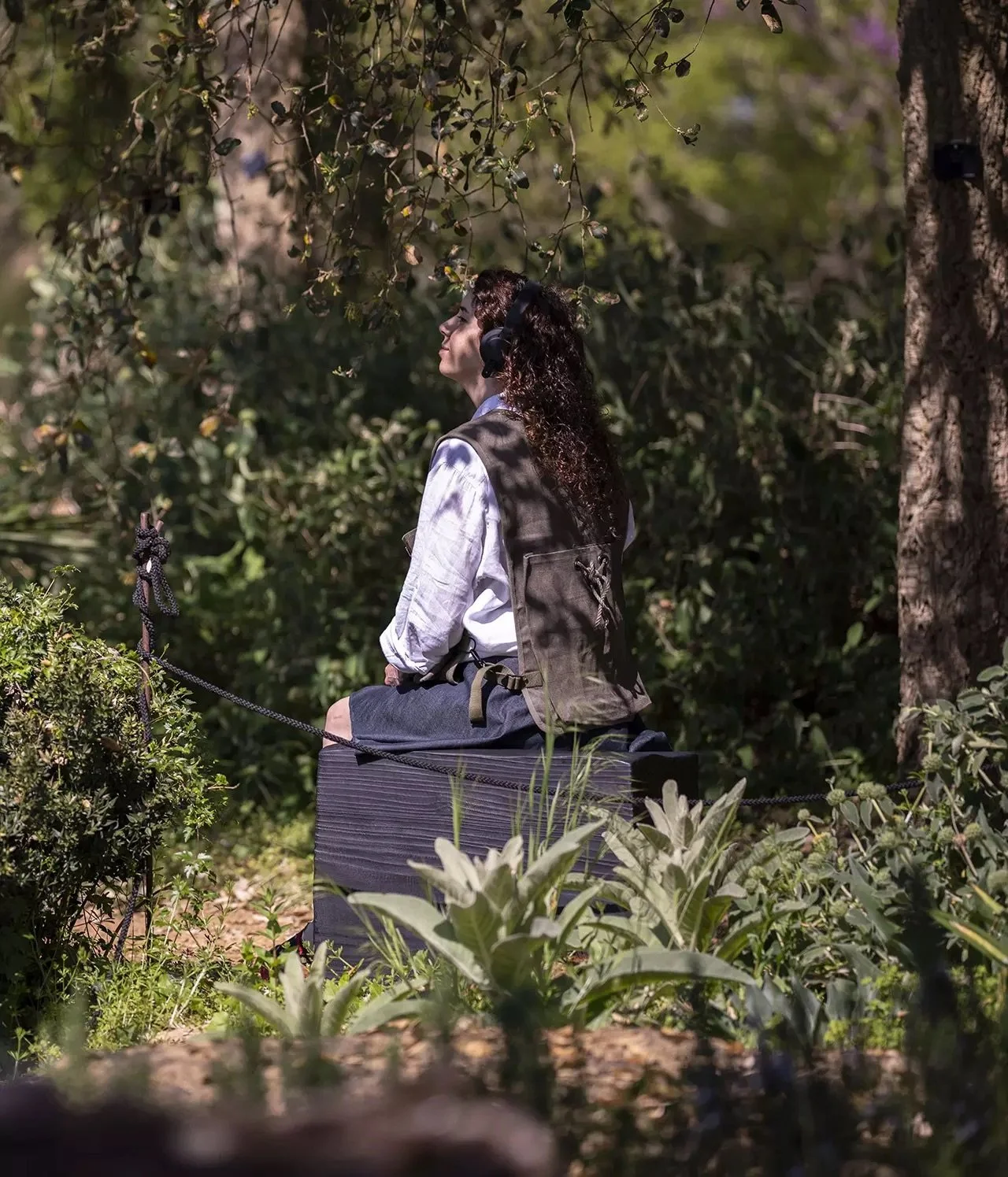
The online field guide for Of the Oak includes a series of open-eyed binaural sound meditations authored by Daisy Lafarge, Merlin Sheldrake, Ella Saltmarshe, and Laline Paull with music by James Bulley. These texts invite the listener to reflect on different ways of engaging with the Oak tree, whether it be through butterflies, time, human culture of mychorrizal fungi.
Credits
An Artwork by Marshmallow Laser Feast: Ersin Han Ersin, Barnaby Steel, Robin McNicholas
Commissioned by Royal Botanical Gardens Kew
Executive Producers: Eleanor (Nell) Whitley, Mike Jones
Producer: Roxie Oliveira
Head of Studio: Sarah Gamper Marconi
Lead Artist: Quentin Corker Marin
Lead Creative Technologist: Chris Mullany
Creative Developer: Sam Twidale
VFX Artists: Nicolas Le Dren, Lewis Saunders
Technical Lead: Miryana Ivanova
Music, Sound Design: James Bulley
Sound System Engineer: Simon Hendry
Assistant Recordist: Jake Tyler, Richard Hards
Recording Musicians: Kat Tinker, Audrey Riley, Daniel Pioro, Ian Stonehouse
Graphic Designer: Patrick Fry
Researcher, Copywriter: Eliza Collin
Marketing and Communications Lead: Erin Wolson
Technical Studio Assistant: Ieva Vaitiekunaite
Studio Administrator & Production Assistant: Alex McRobbie
Online Field Guide Design and Development: Lusion
Lidar Technician: Zachary Mollica
PR: Margaret
Contributing Authors for Meditations
Daisy Lafarge
Merlin Sheldrake
Laline Paull
Ella Saltmarshe
Meditations Voiced by Michelle Newell, Merlin Sheldrake
Scientific Advisors & Contributors
Kevin Martin (RBG, Kew)
Justin Moet (RBG, Kew)
Dr. Laura Martinez-Suz (RBG, Kew)
Lee Davies (RBG, Kew)
Peter Gasson (RBG, Kew)
Dr. Ruth Mitchell
Prof. James McDonald
Dr. Jenni Stockan
Paul Bellamy – RSPB
For Marshmallow Laser Feast
Executive Producers: Alex Rowse, Carolina Vallejo
Senior Producer: Martin Jowers
Producers: Anya Tye, Emmanuel Adanlawo
Tools & Infrastructure Engineer: Maria Astakhova
Social Media Content Manager: Selin Kir
For Installation
Documentation: Lamplight Media Ltd
LED Suppliers: Wheelhouse
Rigging Constructors: Focus Rigging and Scaffolding Ltd
Health & Safety Consultants: Event Safety Plan
Camera Case Design: Sienna Griffin-Shaw